For agencies and content teams
Wordcheck holds a measured voice profile for each of your clients, catches the machine tells and the duplicate paragraphs before work leaves your office, and produces a report under your own logo that goes out with the invoice.
Free plan includes the full analysis engine. No card, no trial clock.
The actual problem
Nobody decides to flatten a client's voice. A junior drafts with AI, someone tidies it, and it happens one convenient draft at a time — usually noticed first by the client, while they are deciding whether to renew.
Built from their published material — sentence rhythm, contraction rate, punctuation habits, function-word signature. Rewrites are held to those numbers, not to a brief that says "confident but approachable".
The same paragraph on four client sites is a quality signal Google reads, and you are the common denominator. Every piece is checked against everything else you have produced — instantly, at no API cost.
Your logo, your accent colour, every score explained in a sentence a client understands. Ninety seconds to produce, and it changes what you can charge for the work.
How it works
Paste three to five things the author has genuinely written — old blog posts, emails, anything. Wordcheck measures 40+ style dimensions and writes a voice brief.
Every flag is highlighted in place, with a plain-English reason and a specific fix. Six weighted categories give you one number out of 100.
Work the list yourself, run the free local pass, or let the AI rewrite against the voice profile. Every rewrite is re-scored, so you see whether it actually helped.
Run the originality check, review each matched source, and export a PDF report — white-labelled with your own logo on the Agency plan.
What's in it
Stock phrasing, tell-tale vocabulary, sentence rhythm, human texture, structure and specificity — each weighted, each explained.
An academic paper legitimately has no contractions. Wordcheck detects formal register and reweights, so it doesn't punish real scholarly writing the way detectors do.
See how closely any text matches a stored voice across 14 dimensions, and exactly which ones are off and in which direction.
A deterministic cleanup that deletes stock phrases and fixes stiff constructions with no API call and no cost. Meaning can't change, because it only makes safe edits.
Distinctive phrases pulled from across the document and searched as exact quotes, with matched spans attributed to their sources.
Compares against everything else in your account. The fastest way for an agency to catch the same paragraph shipped to two clients.
Every endpoint available with a bearer token on Pro and Agency. Wire scoring into your CMS or publishing pipeline.
Agency plans export the full analysis and originality report under your own brand, ready to send to a client.
The deliverable
Not a screenshot of a dashboard. A branded page, written to be read by a client who has never heard of burstiness, that prints straight to PDF.
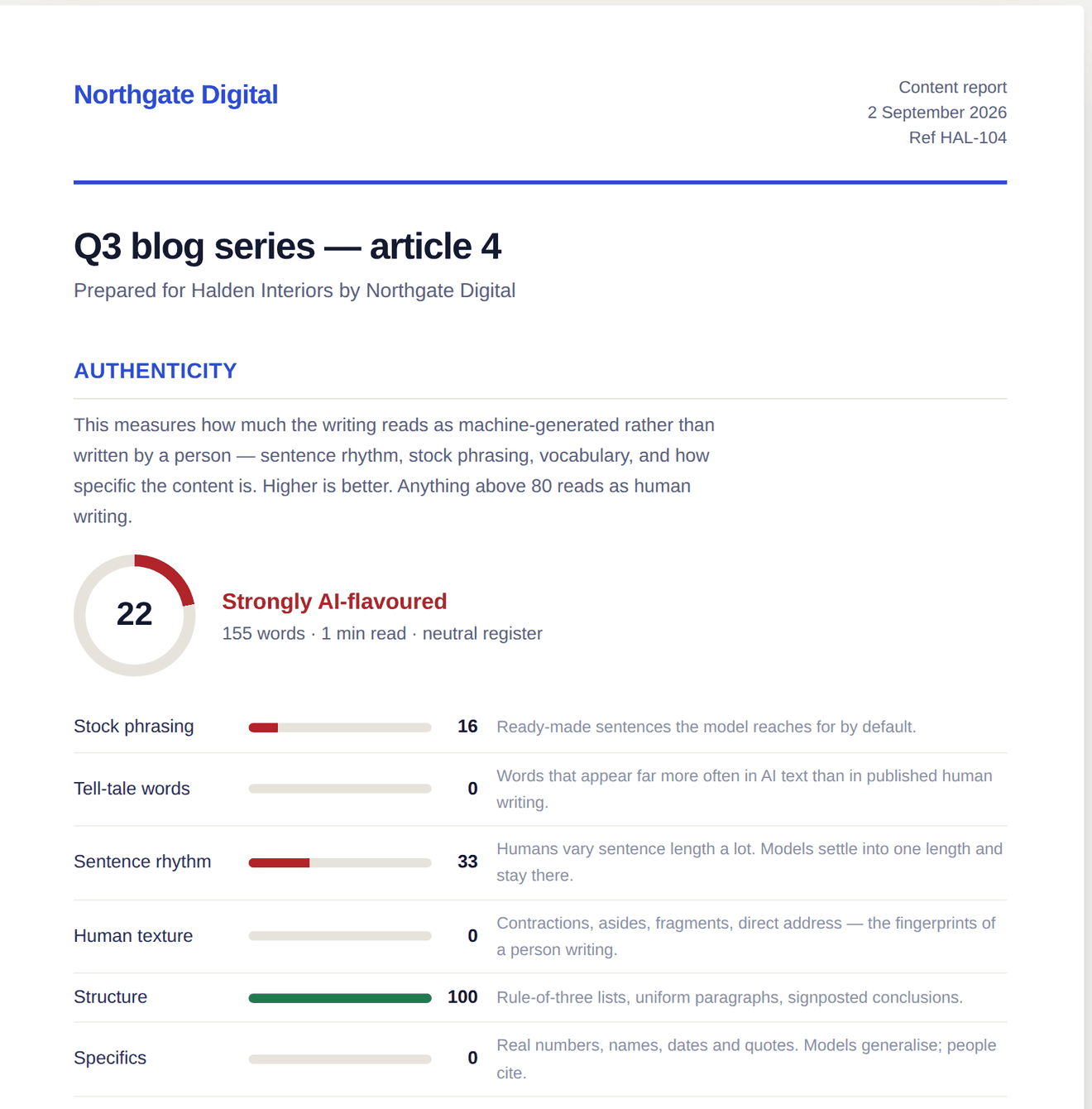
"Here is your article" and "here is your article, voice-matched to your published material, checked for originality, with the report attached" are different products at different prices.
The second one also answers the question every client has started asking — is this AI-written? — before they have to ask it, which is a considerably better position than answering it afterwards.
At £119 a month, the Agency plan pays for itself on roughly one extra article at typical agency rates.
Who it's for
A voice per client, duplicate checking across the sites you manage, white-label reports.
Turn the house voice that lives in one person's head into a number freelancers can work to.
Sound like yourself at volume, and attach a report that answers the AI question up front.
Coach applicants toward their own voice and real specifics. A coaching tool, not a bypass.
Packages
Every plan includes the full analysis engine and the duplicate check. Paid plans add voice rewriting, client reports, more voices and seats for your team.
Score one client’s content and see whether this is real.
A small shop running a handful of clients, or one very busy writer.
The main plan. A client roster, a team signing off work, reports that go out under your name.
Multi-brand groups and agencies running content at volume across many sites.
Score one client’s content and see whether this is real.
A small shop running a handful of clients, or one very busy writer.
The main plan. A client roster, a team signing off work, reports that go out under your name.
Multi-brand groups and agencies running content at volume across many sites.
| Feature | Free | Studio | Agency | Network |
|---|---|---|---|---|
| Client voice profiles | 1 | 4 | 20 | 80 |
| Seats | 1 | 2 | 6 | 20 |
| Words analysed a month | 2,000 | 80,000 | 400,000 | 1,500,000 |
| AI rewriting a month | — | 60,000 words | 300,000 words | 1,200,000 words |
| Web originality checks | 3 | 60 | 400 | 1,600 |
| Duplicate check across your work | ||||
| Client reports | — | |||
| White-label branding | — | — | ||
| Longest document | 1,200 words | 8,000 words | 25,000 words | 60,000 words |
| Bulk upload | — | — | ||
| API access | — | — | ||
| Document history | 5 | 300 | Unlimited | Unlimited |
Straight answers
Sometimes, and we won't build the product around that promise. AI detectors are unreliable in both directions — they flag genuine human writing regularly and miss lightly edited AI text. Any tool selling a guaranteed bypass is selling you a number that moves every time a detector updates.
What we optimise for is writing that is actually good: varied rhythm, real specifics, a consistent voice. That tends to score well on detectors as a side effect, because it has the properties detectors are looking for. It also survives the update after next.
For self-checking and learning, yes — the analysis shows you what makes writing read as generic, and the originality check catches passages you forgot to cite before your university does.
For disguising AI-written work submitted as your own, no. That's academic misconduct at every institution we know of, our terms prohibit it, and we don't sell a "bypass Turnitin" mode. If your university's policy allows AI assistance with disclosure, Wordcheck helps you meet the disclosure honestly.
No, and this is a hard rule in the rewriter's instructions. It will tell you a passage has no specifics in it, and it will refuse to invent them. Adding a plausible-looking figure that nobody can source is worse than having no figure at all.
Six weighted categories: stock phrasing (24%), tell-tale vocabulary (22%), sentence rhythm (18%), human texture (14%), structure (12%) and specificity (10%) — reweighted when a formal register is detected. It's a measurement of writing properties, not a probability that a machine wrote it, and we're careful to describe it that way.
Documents you explicitly save are stored against your account so the internal duplicate check can use them, and you can delete any of them at any time. The instant analyser on this page stores nothing. We don't train models on your content and we don't sell it.
The action is refused with a clear message telling you which limit you hit and what your current usage is. Nothing is charged automatically and nothing is silently truncated. You upgrade if you want to, or wait for the month to roll over.
Yes. It's a single Node application with a SQLite database and no external dependencies at rest. Bring your own API keys for the AI rewriting and search — or run it with no keys at all, in which case the analysis engine, the local rewrite pass and the internal duplicate check all still work.
Free account, no card, full analysis on documents up to 1,200 words. Two minutes to find out whether your content reads like a person wrote it.